Sustainable Locations and Attractions
31 results
Sort:
-
Flower Exhibition by Mrs Károly Kovács Made of Sugar Mrs Károly Kovács was born in 1957 in Lőkösháza, where she has lived ever since. Following in her father’s footsteps, she also became a tailor and seamstress, working in Lőkösháza. She initially created sugar flowers and decorated cakes as a hobby for her family and friends. Through this, her work came to the attention of our town’s mayor, Györgyi Szűcsné Gergely. She encouraged her to participate in the amateur cake-making competition organised by the Mihály Munkácsy Museum in Békéscsaba in 2015, where she received a special award for her cake composition titled “My Grandchild’s Tale.” Later, she completed a sugar flower-making course, where she met Master Confectioner Dr Zoltán, a member of the Békés County Culinary Team. Dr Zoltán noticed her work and, in 2016, invited her to create floral decorations for their table at the Culinary Olympics in Erfurt. Since 2016, she has been making the village day cake for Lőkösháza every year. Her exhibition can be viewed at the Sándor Petőfi Community Centre in Lőkösháza. Magyarország, 5743 Lőkösháza, Alapitók útja 17
-
Statue of the Shepherd Playing the Flute In the centre of the settlement, visitors are welcomed by a charming little park. At its heart stands the public statue of the 'Shepherd Playing the Flute', erected in the year 2000 by the Municipality of Doboz to honour the Millennium. This statue, made of bronze and limestone in a traditional architectural style, was the largest creation to date by sculptor Attila Mészáros. The design was inspired by the connection between Doboz and water, which has shaped the lives of its inhabitants and the history of the settlement. In the past, Doboz was almost encircled by the Black Körös River, giving it an island-like appearance. This is symbolised by the pebble-shaped base made of Süttő limestone. The shepherd playing the flute evokes the settlement's pastoral heritage. Magyarország, 5624 Doboz, Kossuth tér
-
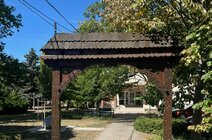
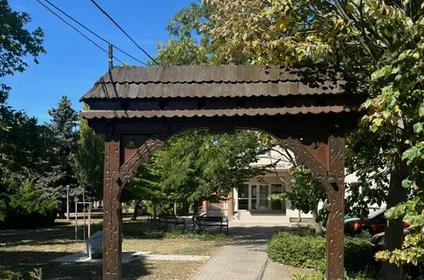
Székely Gate and Memorial Post Our connection with Torja in Transylvania began in 1990 through correspondence with Artúr Coroi, the mayor at the time. Following the 1990 municipal elections, the relationship between the towns of Torja and Gádoros was strengthened, and the first meeting took place in Torja in April 1991. From then on, meetings became regular, occurring several times a year. In 1992, our friends from Torja performed the comedy "Open Window" at the House of Culture, and the next day they ceremoniously presented a small memorial post, handcrafted as a token of their friendship. This can be found in the park in front of the Zsigmond Justh Cultural House. For our second village day on 30 September 1995, our friends from Torja gifted the residents of Gádoros with a Székely gate. The gate was crafted by József Miholcsa, a folk woodcarving artist. At the handover ceremony, András Kováts, the Mayor of Torja, said: "Whoever walks under the Székely gate should always remember that the residents of the twin town belong to Hungary with all their heart and soul." Magyarország, 5932 Gádoros, Doktor Hidasi László utca
-
Tamás Széchy Memorial House, Local History Collection and Creative House Our town's prominent cultural and heritage site is the Tamás Széchy Memorial House, Local History Collection and Creative House. This house preserves the memory of Tamás Széchy, one of Hungary's most successful swimming coaches of all time and the first honorary citizen of Doboz. He spent his childhood in this house, where his mother was the post office manager. Until 2008, this building served as a post office. Later, thanks to a grant, it was renovated and slightly modified, eventually gaining its current appearance. In 2012, it was reopened to the public, housing a permanent exhibition of the swimming legend's personal belongings and providing space for the local history collection, which includes items donated by residents as well as the handiwork of members of the Dobozi Folk Art Association. Its latest addition, the Postal History Exhibition, opened in 2024. This house hosts all kinds of craft workshops, camps, and events that ensure the traditions of the past are not forgotten and are faithfully passed on to future generations. The main goal is to preserve and respect local traditions and values, passing them down "from father to son." A living house and event space with its own herbal garden. The memorial house can be visited by prior arrangement. Magyarország, 5624 Doboz, Nagy utca 20 -
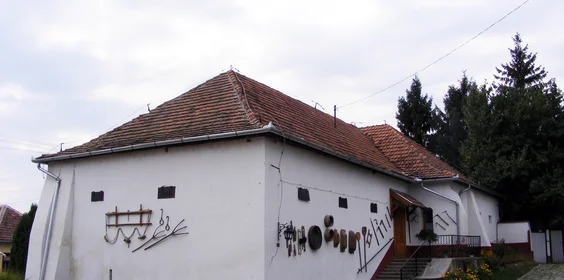
Village Museum, Biharugra Located in the centre of Biharugra, halfway between the Bölöny Mansion and the Reformed Church, stands one of the village's oldest buildings. Magyarország, 5538 Biharugra, Erzsébet utca 50 -
Dobozi Wenckheim Castle The former Wenckheim Castle now functions as the Dobozi Primary School. In 1944, the castle, which originally had 52 rooms, reached its current form in three stages. First, the hunting lodge facing the main road was completed (currently a shop is located here). The single-storey hunting lodge was built by Rudolf Wenckheim based on the plans of Antal Czigler, the estate architect from Gyula, providing a place for relaxation and hospitality after hunts. In 1850, the upper floor of the castle and its extension parallel to the main road were completed, which now form part of the Dobozi Primary School building. The building took on its "U" shape at this time, and around the same period, in 1852, the romantic-style racing stables and coach house were built based on the plans of Miklós Ybl, followed by the triumphal-arched oat silo granary. Doboz became the centre of the estate, from where the Vésztő and Csorvás properties were managed. At the beginning of the 1900s, Dénes Wenckheim constructed the turret-like, mansard-roofed, slate-covered multi-storey section in the courtyard in a historicist style. A marble staircase leads to the upper floor. From the balcony room, there was a beautiful view of the castle park. The rooms featured stunning tiled stoves matching the wall colours. In the dining room, a 4-metre-tall snow-white tiled stove was brought from Belgium. The upper floor served as the living quarters for the countess and the children. The castle was furnished in an aristocratic and sophisticated manner. On the ground floor, the large dining room, among other things, served as the venue for hunting dinners, and many famous people visited the castle during hunts, including Governor Miklós Horthy. By the 1940s, Count Lajos Wenckheim transformed the castle into a true countryside residence. The corridors' walls were adorned with a collection of hundreds of beautiful and valuable roe deer and stag antlers. The Dobozi hunting lodge was well-known in aristocratic circles. Today, the impressive building houses 9 classrooms. In 1996, the building was expanded with a new wing, which included additional classrooms. The old and new building complex now welcomes Dobozi students with a modern computer room, development room, and specialised classrooms equipped with interactive whiteboards. Magyarország, 5624 Doboz, Kossuth tér 15
-
Wenckheim Castle Park Behind the former castle, surrounded by a branch of the Dead Black Körös River, lies a 3.7-hectare castle park, designed by the Wenckheim family in the 1880s in an English style. Its characteristic trees include pedunculate oaks, plane trees, lindens, horse chestnuts, ginkgo, and Scots pine clusters. Since 1979, the park has been a protected natural area, and the leadership of Doboz considers its rehabilitation a top priority. The park features stunning trees that are centuries old. In the picturesque English-style park, you will also find the family mausoleum and chapel (1896-1902). The park was restored in 2006, aiming to recreate its former state by planting new vegetation, creating flower beds, and replacing dead trees. This well-maintained and visually striking park is a favourite spot in the town, where both young and old enjoy strolling under the centuries-old trees and spending their leisure time. We warmly invite our guests to this marvellous natural setting, whose unique climate is shaped by the Dead Black Körös River. Four bridges lead into the park, making this natural wonder in the town centre more accessible. In the western part of the park, there is a sculpture garden paying tribute to former Hungarian kings. Walking through the park and letting your imagination wander, you can picture the everyday life of the former Wenckheim estate, as the former castle, the granary designed by Miklós Ybl, and the chapel and crypt at the park's highest point are all within 'arm's reach' of each other. If you visit Doboz, don’t miss this experience! Magyarország, 5624 Doboz, Sport utca