What Europe is Doing Differently in 2026 – Best Practices in Sustainable Tourism
For a long time, sustainable tourism was seen as a realm of strict restrictions, unexpected extra costs, and guilt. However, in 2026, something fundamentally changed. More and more European destinations realised that instead of imposing bans, they could achieve real breakthroughs by involving visitors, encouraging them, and raising their awareness of sustainability. As travellers, we are no longer passive observers or a "burden to be tolerated" by a destination, but active partners in its preservation. This also sends a clear message to the tourism industry: there is no single, universal solution; each region must tailor its responses to its own local characteristics and communities.
The Norwegian model: When you can clearly see where your money goes
At the start of summer, much of the international press focused on Norway's new visitor contribution. The topic was presented as if Norwegian accommodation would become roughly three percent more expensive from the summer of 2026. However, the reality is far more intriguing.
The law, which came into effect on 1 July, does not impose an automatic fee but instead provides municipalities with the legal option to apply for its introduction. In their application, they must clearly justify where and how tourism impacts local public services and explicitly detail how the revenue would be used. The fee can be up to three percent and can only be spent on tourism infrastructure – such as public toilets, hiking trails, parking systems, or waste management – and cannot be absorbed into the general municipal budget. Camping, tenting, and motorhome travel are exempt from the rule, which has made the proposal politically and socially acceptable.
The six municipalities of the Lofoten archipelago are already preparing a joint application, and the regional council has even hired a dedicated staff member for the task. The first traveller to actually see this fee on their bill is expected to arrive in the second half of 2027.
It’s important to note that international experience shows that small tourism fees rarely change travellers' habits on their own (see Venice). Where they do have an impact, they typically encourage off-season travel and longer stays – in other words, they redistribute demand rather than suppress it.
Encouragement over passive appeals: The CopenPay model and green experiences
Copenhagen is also one of the biggest beneficiaries of the Coolcation trend: with masses of travellers seeking a more pleasant summer climate, the Danish capital had to manage the growing number of visitors while remaining truly green. Denmark's CopenPay demonstrates how abstract sustainability appeals can be transformed into tangible, joyful experiences. Instead of relying solely on visitors' goodwill, the system directly rewards green choices: if you arrive by public transport, join a community park beautification project, or order plant-based meals, the city thanks you for your mindfulness with free museum tickets, guided tours, or a hot coffee.
The model has since been adopted by Berlin, Bremen, and Helsinki, proving that fostering eco-conscious habits can also be experience-driven. Travellers realise that their decisions have a direct, positive impact on the area, while tourism stakeholders learn that unique incentives, building on the capacities of local businesses, can bring them closer to their guests.
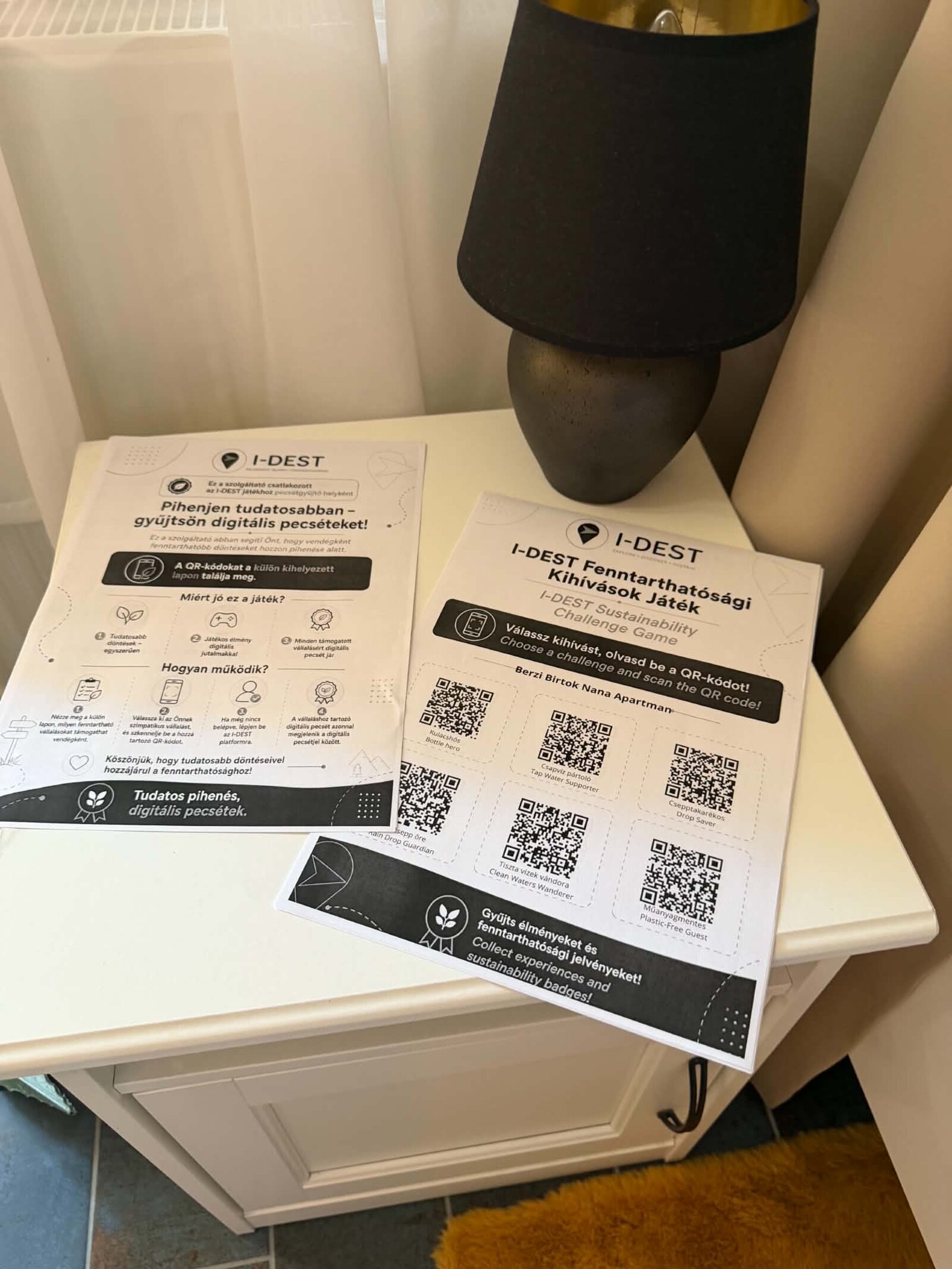
There is also a Central European adaptation of the programme, as Hungary's Sárvár GoGreen programme operates similarly on a municipal level. Likewise, the I-DEST sustainability challenge game, launched by our platform, follows a similar approach.
Water retention: This year's most critical issue
While the north is dealing with increased traffic due to the Coolcation trend, the Mediterranean region faces a critical situation caused by dry winters and the peak summer season. In Greece, eight islands – including Poros, Tinos, Patmos, and Karpathos – have declared a state of emergency due to water shortages, and Corfu's situation has also become severe. However, the response is not panic but intelligent adaptation. On Astypalaia, temporary desalination plants and irrigation restrictions have been implemented, while hotels are considering using seawater in pools and installing rainwater cisterns. Travellers are also being encouraged to be more mindful, as skipping unnecessary daily towel changes or cleaning services in hotels directly helps reduce the pressure on local communities.
In Mallorca, the focus is already on water retention: alongside renewable energy-powered desalination plants, urban rainwater retention is being strengthened, and drought-resistant Mediterranean plants are being planted in public spaces and new developments. This is the smartest step, as it permanently reduces irrigation needs while keeping the environment green and attractive.
The Mediterranean islands are now learning the lesson that the continent's interior, drying regions – such as lake resort areas or thermal spa destinations – will soon face. It will be fascinating to observe in the coming years how these destinations – much like many domestic spa towns – respond and how quickly they adapt.
Circular economy: Plastic-free relaxation, Dubrovnik's example
Dubrovnik has taken remarkable steps towards plastic-free tourism by banning single-use plastics from events and municipal institutions and turning waste retrieved from the sea into local souvenirs and sunglasses. This practice helps guests reduce their waste effortlessly during their travels and see the circular economy in action up close. In light of the upcoming strict EU packaging regulations, Dubrovnik's example sends a message to the sector: environmental regulations should not be seen as burdens but as unique operational solutions that strengthen local identity.
Rewilding: When restoring nature becomes the experience itself
Conservation has long been seen as a constraint in tourism planning. Rewilding-based developments turn this on its head: the restoration process itself becomes the experience.
This year, Rewilding Europe launched its own booking platform, Wilder Places, which invites visitors to areas undergoing restoration. In Sweden, Rewilding Sweden and a wilderness travel company have jointly developed a "rewilding week," where guests participate in fieldwork. In Croatia's Velebit region, the expansion of wildlife observation infrastructure continues: alongside the existing five hides, three more are being installed, and photo safaris are being enhanced with purpose-built locations.
In the north, the Finnish-Swedish REGGAE project goes a step further: it is building a tourism model where travel simultaneously supports ecological restoration, community well-being, and visitor health.
What does the future hold?
The common thread in the above examples is that none of them are about reducing visitor numbers. They are all about destinations knowing what is happening within their borders and distributing pressure, resources, and revenue accordingly. This is precisely the capability measured by the GSTC criteria: not the intention, but measurable, documented practice.
The European Commission's upcoming sustainable tourism strategy also confirms that the future of travel is based on partnership. It’s not about excluding tourists but about helping travellers understand the impact of their decisions, while destinations intelligently distribute pressure and resources according to their own capacities. This is how sustainability evolves from mere intention into a measurable, tangible, and lovable reality for all of us.
More News
All-
5 Mins

Read -
4 Mins
Read -
4 Mins

Read -
4 Mins

Read -
3 Mins

Read -
3 Mins
Read -
5 Mins
Read -
3 Mins

Read -
3 Mins

Read -
4 Mins

Read -
3 Mins

Read -
7 Mins

Read -
19 Mins
Read -
7 Mins

Read -
8 Mins

Read -
5 Mins

Read -
4 Mins

Read -
7 Mins

Read -
5 Mins

Read -
3 Mins

Read -
4 Mins
Read -
3 Mins

Read -
3 Mins

Read -
3 Mins
Read -
12 Mins

Read -
4 Mins
Read -
4 Mins

Read -
4 Mins

Read -
4 Mins

Read -
5 Mins
Read -
4 Mins

Read -
3 Mins

Read -
8 Mins
Read -
4 Mins
Read -
6 Mins
Read -
4 Mins

Read -
5 Mins

Read -
6 Mins

Read -
5 Mins

Read -
3 Mins

Read -
7 Mins

Read -
7 Mins

Read -
5 Mins

Read -
6 Mins

Read -
6 Mins

Read -
3 Mins

Read -
3 Mins

Read -
10 Mins

Read -
6 Mins

Read -
5 Mins

Read -
4 Mins

Read -
5 Mins

Read -
4 Mins

Read -
6 Mins

Read -
7 Mins

Read -
5 Mins

Read -
3 Mins

Read -
4 Mins

Read -
4 Mins

Read -
4 Mins

Read -
6 Mins

Read -
3 Mins

Read -
1 Mins

Read -
2 Mins

Read -
2 Mins

Read -
3 Mins

Read -
3 Mins

Read