83 sustainable tourism certifications in one list: Travalyst releases updated register
On 24 July 2026, Travalyst updated the official list of sustainability certifications. Just two months before the European Union's new green regulation (ECGT) comes into effect, this document has become the key reference point for hotels, guesthouses, and smaller accommodations.
What is Travalyst, and why should you pay attention to it?
Travalyst is an independent, non-profit coalition launched in 2019 at the initiative of Prince Harry, Duke of Sussex. The initiative brings together some of the biggest players in the global travel and technology sectors: Booking.com, Google, Skyscanner, Tripadvisor, Expedia, and Amadeus.
The goal is simple: to ensure that travellers can clearly see, in a unified and comparable format, how sustainable the accommodation they choose is at the time of booking.
However, this requires tidying up the jungle of green labels. Globally, there are hundreds of sustainability certifications, with significant differences in rigour, transparency, and oversight. Guests cannot distinguish between genuinely independently audited accommodations and those that have created their own certificates – and booking platforms have struggled to determine which logos they can display. This led to the launch of the Travalyst Certifications Initiative. The second phase of the initiative, announced in 2026, not only uses its own standards but is fully aligned with the incoming EU regulations. This resulted in the list published on 24 July 2026, whose certifications will now prominently feature on booking platform interfaces.
The ECGT: the stakes rise in September
The EU's Empowering Consumers for the Green Transition (ECGT) directive comes into force on 27 September 2026. The regulation aims to put an end to unfounded green claims (greenwashing) once and for all. From September, sustainability labels can only be displayed to consumers if they are based on a certification system that meets four strict criteria:
-
Open and transparent: accessible to anyone under fair conditions.
-
Professionally grounded: requirements are developed with input from experts and stakeholders.
-
Includes a sanction system: provides procedures for addressing non-compliance (including revoking the label).
-
Backed by independent audits: verification is conducted by a third party whose expertise and independence are based on standards.
The biggest challenge: Those relying on self-declaration will now need genuine, independent third-party audits.
Travalyst is not a regulatory authority, so it does not review or approve systems. Certifiers declare their compliance by completing a declaration, and the legal responsibility remains with them and the service providers. The list is therefore a transparency tool – but in practice, major booking platforms use it to decide which accommodations can display a “green” label on their interfaces.
What does the 24 July update show?
The updated register lists 83 accommodation certification systems. This high number highlights the fragmented nature of the market but also shows how seriously stakeholders are taking the September deadline.
The key takeaways from the list:
-
Dual focus has become the norm: Of the 83 systems, 73 assess both environmental and social aspects. Only 9 focus solely on environmental factors (e.g. Nordic Swan Ecolabel, DEHOGA Umweltcheck) and 1 exclusively on social factors (Queervadis).
-
Accreditation is the bottleneck: For most systems, the accrediting body is still listed as “N/A.” Where accreditation exists, it is most often provided by GSTC, the UK’s UKAS, or a national authority.
-
Transparency is mandatory: It is now compulsory to disclose the details of the independent auditor and accrediting body. This ensures visibility not only of who made the declaration but also of the verifying background.
Highlighted examples
Among the global field, two systems stand out on the list, which I-DEST strongly recommends:
1. Good Travel Seal
The Dutch Green Destinations programme targets SMEs and is based on the international GSTC criteria. Over the past year, the certification system has undergone significant changes to align with EU expectations, and under the new system, the first domestic businesses will soon be able to obtain certification.
-
Why is it outstanding? Travalyst cites the structure of the Good Travel Seal as a textbook example of independent certification. The standard owner (Green Destinations Services) and the certifying body (Good Travel Institute) are legally completely separate, with their own certification committee and trained auditor network.
2. Bioscore sustainability certification
Based in Valencia, this technology-driven system follows the ESG logic (environmental, social, and governance criteria). It assesses six main areas – from carbon footprint and energy efficiency to waste reduction and social responsibility – and ranks results from C to A+.
-
Why is it outstanding? Bioscore is backed by a particularly strong chain of independent auditors: internationally recognised certification bodies such as OCA Global, TÜV Rheinland, and Bureau Veritas carry out the verifications. This fully meets the strictest ECGT requirements.
What should you do now?
If you run an accommodation or tourism business, you have just two months left to rethink your sustainability communication.
-
If you already have a certification: Check whether the system you use is included in Travalyst’s 24 July list!
-
If you don’t yet have a certification: It’s worth starting as soon as possible, as the process of obtaining a credible, independent audit can take months.
Travalyst’s register is continually updated with ongoing declarations, and the latest version is always available on the organisation’s official website.
And what comes before certifications: I-DEST’s Global Sustainability Challenges
So far, one assumption has been implicit: that the provider has already reached the stage of applying for an audit. In reality, in many countries, much of the tourism offering is not there yet. For a twenty-room guesthouse or a three-person travel agency, an international certification is currently neither affordable in terms of time nor cost – but that doesn’t mean there’s nothing they can do for sustainability, and their guests increasingly expect it.
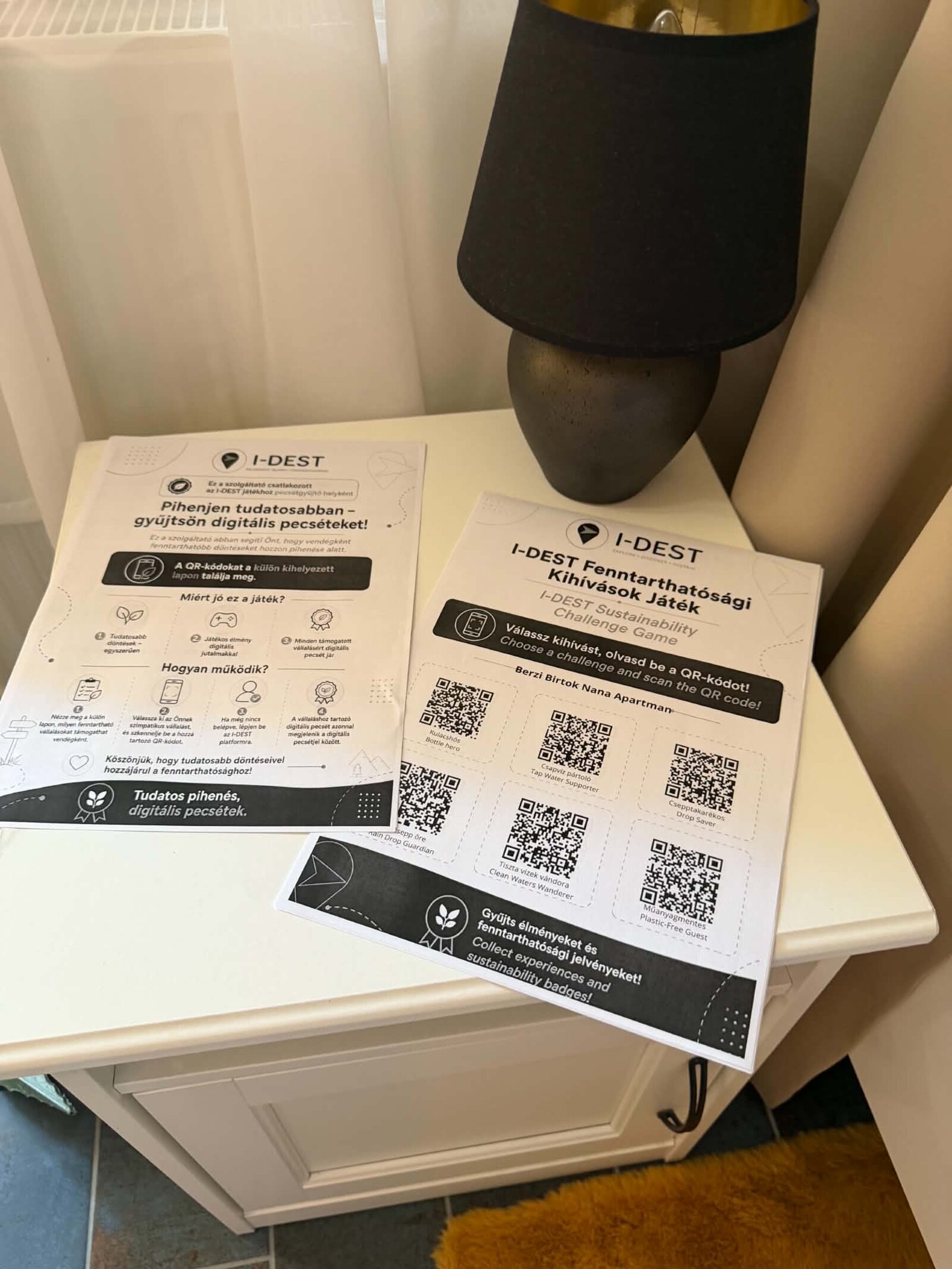
This preparatory phase is supported by I-DEST’s Global Sustainability Challenges.
The logic is reversed compared to certifications. The digital badge is not awarded to the provider but earned by the guest – for their own sustainability actions. For taking the train, cycling around the area, buying from local producers, or opting out of daily linen changes. The guest is therefore not a passive label reader but an active participant: they receive feedback for the small decisions they make during their trip.
The provider’s role is to make this possible. Badges can only be collected where the business has created the conditions – where bikes are genuinely available, local products are truly offered, and real choices exist. To ensure this doesn’t remain an empty promise, commitments are checked through random mystery shopping. If the system tells the guest they can do something, they must actually be able to do it. Guest feedback is also rewarded, as everyday experiences often provide a more accurate picture than any self-declaration.
Why is this important for the ECGT? Because the Challenges do not – and structurally cannot – make sustainability claims about the business itself. They are not a badge, label, or certification. This places them outside the regulatory scope that tightens from 27 September. However, the directive’s spirit is not just about tidying up labels but also about ensuring consumers receive genuine, understandable, and verifiable information to guide their decisions. The gamified format supports this by communicating not abstract promises but concrete, actionable steps – and the guest experiences firsthand what they mean.
For the business, it provides self-awareness. While making the challenges available, they gain a clear understanding of where their offering stands, what infrastructure they have, and what they lack. This assessment is the best preparation for confidently entering a serious, independent certification process a few years down the line – when the capacity and determination are there. Tackling a Good Travel Seal or Bioscore audit with experience is vastly different from starting from scratch.
I-DEST’s Global Sustainability Challenges are therefore not competitors to Travalyst’s current systems. They represent the first stage of the journey – starting where the majority of the sector is today.
More News
All-
3 Mins

Read -
5 Mins

Read -
4 Mins

Read -
4 Mins

Read -
4 Mins

Read -
3 Mins

Read -
3 Mins
Read -
5 Mins

Read -
6 Mins

Read -
3 Mins

Read -
3 Mins

Read -
4 Mins

Read -
3 Mins

Read -
19 Mins
Read -
7 Mins

Read -
8 Mins

Read -
5 Mins

Read -
4 Mins

Read -
7 Mins

Read -
5 Mins

Read -
3 Mins

Read -
4 Mins

Read -
3 Mins

Read -
3 Mins

Read -
3 Mins

Read -
12 Mins

Read -
4 Mins

Read -
4 Mins

Read -
4 Mins

Read -
4 Mins

Read -
5 Mins
Read -
4 Mins

Read -
3 Mins

Read -
8 Mins

Read -
4 Mins
Read -
6 Mins

Read -
4 Mins

Read -
5 Mins

Read -
6 Mins

Read -
5 Mins

Read -
3 Mins

Read -
7 Mins

Read -
7 Mins

Read -
5 Mins

Read -
6 Mins

Read -
6 Mins

Read -
3 Mins

Read -
3 Mins

Read -
10 Mins

Read -
6 Mins

Read -
5 Mins

Read -
4 Mins

Read -
5 Mins

Read -
4 Mins

Read -
6 Mins

Read -
7 Mins

Read -
5 Mins

Read -
3 Mins

Read -
4 Mins

Read -
4 Mins

Read -
4 Mins

Read -
6 Mins

Read -
3 Mins

Read -
1 Mins

Read -
2 Mins

Read -
2 Mins

Read -
3 Mins

Read -
3 Mins

Read